Halaman

Showing posts with label Endangered Species. Show all posts

Saturday, October 30, 2021

Endangered Species 05 : Celastrus paniculatus Willd

Scientific classification
Kingdom: Plantae
Family: Celastraceae
Genus: Celastrus 
Species: Celastrus paniculatus Willd. 
Distribution: Global: Indo-Malaysia to Chinaand Australia.
National: Occurring throughout the country in Himachal Pradesh, Gujarat, Madhya Pradesh, Maharashtra, Goa, Karnataka, Kerala and Tamil Nadu.
Regional: Common throughout southern states, more abundant in drier hill tracts.


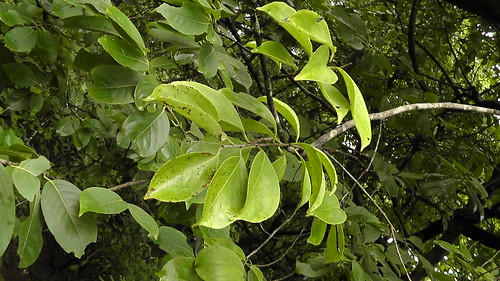
Description: A large woody climbing shrub. Bark brown, thin. Branchlets hairless, with many distinct minute white dots called lenticels. Leaves alternate, egg-shaped to oblong-elliptic, about 5-15 x 2-8 cm, base round, apex acuminate, margin toothed with rounded teeth, hairless; lateral nerves 5-8 pairs, slender; leaf stalks about 3 cm long. Flowers unisexual, about 6 mm across, greenish white, collected in terminal paniculate cymes; panicles 5-30 cm long, pendulous. Capsules sub-globose, 5-10 mm across, smooth, yellow when mature, transversely wrinkled, dehiscing by 3-valves. Seeds 1-6, ellipsoid or ovoid, about 6 x 3 mm, yellowish brown, enclosed in crimson-red aril.

Phenology: Flowering: February to April;
                   Fruiting: May to December

Medicinal uses: The stem bark is used as an abortifacient and brain tonic. Leaf sap is a good antidote for opium poisoning. Seeds are stimulant, diaphoratic, diuretic, tonic, appetizer, anti-inflammatory and used for abdominal disorders, leprosy, pruritus, skin diseases, paralysis, asthma, leucoderma, cardiac debility, inflammation, amenorrhoea and fever. Also used to stimulate the intellect and sharpen memory. The seed oil is used to cure berbery, sores and to promote intelligence and sharpen memory.


Propagation: By seeds and stem cuttings

Endangered Species 04 : Munronia pinnata (Wall.) Theob

Scientific classification
            Kingdom: Plantae
Family: Acanthaceae
Genus: Munronia
Species: Munronia pinnata (Wall.) Theob.
Description
Usually unbranched shrublet, 5- 30 cm tall, stems up to 7 mm diameter, root system with a tap root. Leafy shoots with leaves forming an apical rosette. Flowers hermaphrodite and in few flowered thyrses or solitary. Fruit a 5-valved loculicidal capsule, each locule 1 or 2 seeds. Seeds are brown.


There are morphological variations among populations through out its geographical range especially in leaf habit, leaflet number, leaf shape, leaf margin, colour of marginal vein, hairiness of plants colour of flowers.
Distribution
Found in southern and northeastern India, Nepal to South China, Vietnam, Burma, Thailand, Malaysia, Jawa, Bali, Sumba, Flores, Solor and Timor. Cultivated in Europe in glass houses.In Sri Lanka this plant has been recorded in Ritigala, Doluwa, Naula, Mathurata, Haldumulla, Wellawaya, Balangoda, Katharagama, Sigiriya, Polonnaruwa and Lunugala areas.
Medicinal value
The entire plant is used for medicinal purposes to treat fever, dysentery, leprosy and other skin diseases and for purification of blood

Sunday, October 10, 2021

Endangered Species 03 - Coscinium fenestratum (Gaertin.) Colebr.

Scientific classification

Kingdom: Plantae 
Family: Menispermaceae 
Genus: Coscinium 
Species: Coscinium fenestratum (Gaertin.) Colebr.

Discription

Woody dioecious climber with a smooth bark, large rounded leaves with prominent 5-7 veins. The wood is of bright yellow color and is valued in ayurvedic medicine.


Distribution

Found in open or disturbed areas of lowland rain forests.

Medicinal importance

Dried stems are used for treating diseases of the skin, uterus, urinary system, eyes, gums, kidney, diabetes and wounds. It is also used in the treatment of fever, common colds and tetanus, to overcome body aches and pains, as a blood purifier and for the prevention of tetanus. The active components of the stem of this plant are believed to act on blood circulation system and on the skin.

Propagation

Propagated by seeds and rooted cuttings (But hard to propagate by both means)


Endangered Species 02 - Salacia reticulata

Scientific classification

Kingdom: Plantae 
Family: Hippocrateaceae/ Celestaraceae 
Genus: Salacia 
Species: Salacia reticulata wight

Distribution

In dense evergreen forests throughout India especially southern India and Sri Lanka.

A woody climber grows on bushes and hedges. Bark smooth, greenish grey and thin. Leaves simple, opposite, ovate oblong, acuminate, coriaceous, crenate, glabrous and having shining surfaces. Flowers bisexual, yellowish green in woody axillary tubercles; fruits globose, pinkish orange, contain 1-4 seeds immersed in pulp.


Medicinal Properties

Roots contain salaretin and mangiferin which reduces the sugar level and protect the body from any secondary side effect of diabetes. Indian research has shown that active ingredients having hepatoprotective effects so used as a liver tonic. It is very effective in case of rheumatism, menstrual disorders, skin diseases inflammations, spermatorrhoea too.
 
Propagation

Propagated by seeds

Endangered Species 01 - Red Sandalwood

Scientific classification

Kingdom: Plantae 
Family: Fabaceae 
Genus: Pterocarpus 
Species : Pterocarpus santalinus L.

Importance

Red sandalwood or red sanders (Pterocarpus santalinus) is a woody plant species of 20- 25 feet high, covered with rough bark and bearing spikes of yellow flowers which is highly valued for its heavy, dark claret-red heartwood which yields 16% of red colouring agent named Santalin; Santal, Pterocarpin and Homopterocarpin are three other crystaline colouring matters have also been present in the heartwood. Sandalwood is called the red wood because of its colour. Those colouring matters are being used in pharmaceutical, paper, pulp, soap, food and textile industries to yield a dark maroon to purple colour.

In Ayurvedic medicine, red sandalwood is being used as an antiseptic, wound-healing agent, and in anti-acne treatments. Large quantities of wood chips and powder are exported annually mainly for the extraction of dye, medicine and cosmetics. Red sandalwood powder can be made into a paste with honey and water and used directly on the face. It can also be combined with ashwagandha and cosmetic clays or mud for a detoxifying facial. Its texture is hard, which makes it excellent material for making furniture and wood carving.

Geographical Distribution:

Pterocarpus native to India It is most commonly found in south and south-western India, notably in the state of Karnataka, Chittoor District of Andhra Pradesh, and Chingleput in Tamil Nadu. It is cultivated also in China, Pakistan and Philippine Islands and the forests are classified by champion and Seth (1961) under southern tropical dry deciduous forest. The population size of red sanders in Sri Lanka is limited only to a handful of trees, which has risen from seedlings brought from India about 40-50 years ago, and established mainly in Matara DistrictIt is endemic to Cuddapah and Chittoor districts and in some parts of Nellore district. Recommended for plantation on lateritic loam, quartzite shale and lime stone. It requires perfect drainage and is found mainly on stony or gravelly soils.

Propagation

Red sandalwood is conventionally propagated through seeds and vegetative methods. Propagation through seeds is somewhat difficult due to hard seed coat coupled with low viability and presence of phenolic compounds. Although most of the available mother trees have reached the bearing stage, collection of seeds for germination purposes was both difficult and costly. Even though seeds bear seasonally, there is no consistent bearing habit. Some plants produce seeds at certain period of the year, while others do not. In the subsequent year, same plant may not produce seeds during same period of time. Plants, which produce seeds in certain period of this year, may produce seeds during another period in next year. On the other hand, even though a single red sandalwood tree produces several thousands of seeds, no single seedling can be found under the tree mainly due to seed dormancy.

Therefore, due to the seasonal fruit bearing habits and morphological differences among the plants, seed propagation encountered with several limitations. Also, due to limited number of plants available in Sri Lanka and their heights (most of the plants are more than 50-60 meters high and foliage is confined to only in tops) create difficulties when seeds were harvested.

Conventional vegetative propagation studies have also shown that propagation through air layering or cuttings are not up to the satisfactory level. This is mainly because the matured red sandalwood tree is very tall; it is difficult to practice the layering process. Cuttings found to be hard to root even with the application of growth regulators. Limited number of planting materials which were resulted through vegetative means not fulfills the conservation and mass scale propagation of this endangered species.

Tissue culture of red sandalwood also began in the 1980s with more recent attempts to improve shoot sprouting using seedling explants in India