Scientific classification
Kingdom: Plantae
Family: Celastraceae
Genus: Celastrus
Species: Celastrus paniculatus Willd.
Distribution: Global: Indo-Malaysia to China and Australia
National: Occurring throughout the country in Himachal Pradesh, Gujarat, Madhya Pradesh, Maharashtra, Goa , Karnataka, Kerala and Tamil Nadu.
Regional: Common throughout southern states, more abundant in drier hill tracts.
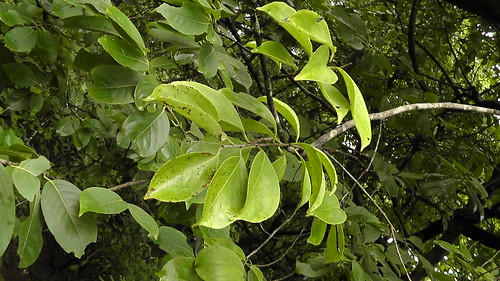
Description: A large woody climbing shrub. Bark brown, thin. Branchlets hairless, with many distinct minute white dots called lenticels. Leaves alternate, egg-shaped to oblong-elliptic, about 5-15 x 2-8 cm, base round, apex acuminate, margin toothed with rounded teeth, hairless; lateral nerves 5-8 pairs, slender; leaf stalks about 3 cm long. Flowers unisexual, about 6 mm across, greenish white, collected in terminal paniculate cymes; panicles 5-30 cm long, pendulous. Capsules sub-globose, 5-10 mm across, smooth, yellow when mature, transversely wrinkled, dehiscing by 3-valves. Seeds 1-6, ellipsoid or ovoid, about 6 x 3 mm, yellowish brown, enclosed in crimson-red aril.
Phenology: Flowering: February to April;
Fruiting: May to December
Medicinal uses: The stem bark is used as an abortifacient and brain tonic. Leaf sap is a good antidote for opium poisoning. Seeds are stimulant, diaphoratic, diuretic, tonic, appetizer, anti-inflammatory and used for abdominal disorders, leprosy, pruritus, skin diseases, paralysis, asthma, leucoderma, cardiac debility, inflammation, amenorrhoea and fever. Also used to stimulate the intellect and sharpen memory. The seed oil is used to cure berbery, sores and to promote intelligence and sharpen memory.
Propagation: By seeds and stem cuttings

